

A customer once asked us to install a loft tank on a roof that, once we looked properly, couldn’t take the weight once full. He’d already bought it. That’s the sort of decision worth making before you order, not after, which is exactly why the cylindrical vs loft tank Kenya question matters more than people assume when they first start shopping.
What Actually Separates the Two Shapes
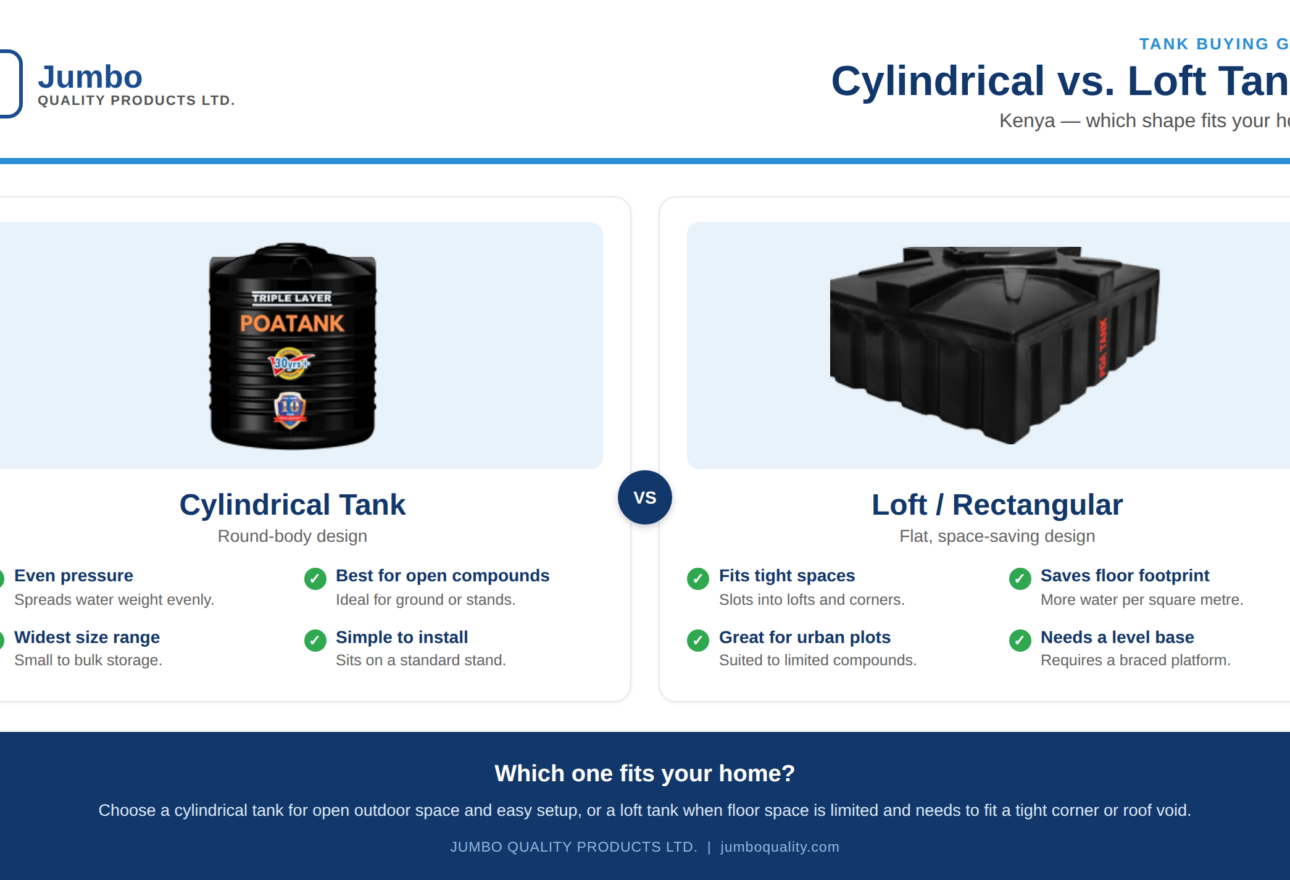
A cylindrical tank sits on the ground or on a low stand, usually on a concrete or block base built to spread its weight evenly. Once it’s up, it stays there. It’s the straightforward option, and for a lot of homes, it’s genuinely the easier one to install and maintain.
A loft tank, by contrast, sits raised, either on a rooftop platform or an elevated stand within the compound. The whole point of putting it up there is gravity. Water flows down to your taps under its own pressure rather than needing a pump, which matters a lot if your area has patchy electricity or you’d rather not run a pump at all.
Ground-Level Cylindrical: What It Needs
Space is really the main requirement, level ground and a solid base strong enough to hold the tank once it’s full. A 5,000 litre tank weighs several tonnes with water in it, so the base isn’t optional or something to improvise on site. Beyond that, cylindrical tanks are about as low-maintenance as tank ownership gets.
Raised Loft: The Trade-Offs Worth Knowing
The pressure benefit is real, and it’s a big reason people choose loft tanks despite the extra installation complexity. The catch is structural. A filled loft tank puts real load on whatever’s holding it up, roof, frame, or stand, and that load needs proper engineering, not a guess. This matters even more on smaller plots where a loft tank saves ground space you’d otherwise need for a cylindrical one, since the raised option genuinely earns its keep there.
Common Sizes in Each Shape
Cylindrical tanks come in the widest range, anywhere from small 500 litre household units up to large 10,000 litre-plus tanks for farms or businesses. Loft tanks tend to run smaller, since structural limits cap how much weight most roofs or stands can safely take, though larger loft options do exist for reinforced setups.
Which One Actually Suits Your Property
If you’ve got the ground space and don’t mind relying on a pump for pressure, cylindrical is the simpler, lower-risk choice. If your plot is tight or you want gravity-fed pressure without pump costs, loft is worth the extra installation planning, provided the structure underneath can genuinely take the load.
We’ll cover the full structural and installation requirements for loft tanks in more detail shortly, since that’s a decision worth getting right the first time. For now, our full range of Cylindrical Water Tank Kenya and Loft Tanks Kenya options is worth browsing on the Poa Tanks product range to see current sizes and pricing. Not sure which capacity you actually need first? Our water usage calculator is a quick way to work that out before you commit to a shape. Structural load considerations for raised tanks referenced here follow guidance from the National Construction Authority, since roof or frame loading is a genuine safety factor worth checking before installation.
Ready to size and shape your tank properly? WhatsApp our team for a same-day quote.
FAQs
Is a loft tank better than a cylindrical tank?
Not really, it depends on your plot. Loft tanks give you gravity-fed pressure and free up ground space, cylindrical ones are just easier to install and don’t come with any structural questions to answer first.
Do loft tanks need special roof reinforcement?
Usually. A full loft tank is heavier than people expect, so whatever’s holding it up needs checking, and reinforcing if it can’t already take that weight safely.
What size cylindrical tank is common for a household in Kenya?
Most households land somewhere between 1,000 and 5,000 litres. Where exactly depends on how many people you’re storing water for and how much of a buffer you want.
Can I switch from a cylindrical tank to a loft tank later?
You can, but it’s not a simple swap. Going raised means new structural work, not just moving the tank you already have onto a stand.
Which shape works better without a water pump?
Loft, hands down. Gravity does the job once the tank’s up high enough, no pump needed to get usable pressure at your taps.