

Farming in Kenya is not for the faint-hearted. You plan, you plant, and then the rains simply don’t arrive when you need them. Or they arrive all at once, run off the land, and disappear before your crops can use a drop of it.
That’s the reality for millions of smallholder and commercial farmers across the country — and it’s exactly why large-capacity water tanks have moved from a “nice to have” to a genuine necessity on working farms.
This isn’t about buying the biggest tank you can find and calling it a day. It’s about storing water smartly, matching your tank to your land, and making sure your irrigation never depends on the weather cooperating.
Why Water Storage Is the Missing Piece in Most Farm Setups
Most farms in Kenya have some form of water access — a borehole, a river nearby, seasonal rainfall. The problem isn’t usually the source. It’s the timing.
Rainfall doesn’t arrive on your planting schedule. Boreholes run lower in the dry season. Rivers drop. And when that happens, crops fail — not because there wasn’t enough water in the year, but because there wasn’t enough water on the right day.
Large capacity water tanks solve this by decoupling your water supply from the weather. You collect when water is available. You irrigate when your crops need it. The two no longer have to line up perfectly.
What Counts as “Large Capacity” for Agriculture?
This depends entirely on what you’re growing and how much land you’re managing.
For a small-scale kitchen garden or a quarter-acre plot, a 5,000-litre tank is workable. But for serious horticultural farming, greenhouse operations, or anything above one acre under active irrigation, you’re typically looking at:
- 10,000 litres — suitable for smallholder farms with supplemental irrigation needs
- 20,000–50,000 litres — the practical range for medium commercial farms
- 100,000 litres and above — for large-scale operations, community water storage, or farms in arid counties like Machakos, Kitui, or Turkana
The right size isn’t always the biggest one you can afford. Oversizing leads to stagnant water, algae problems, and wasted spend. Size your tank to your actual water demand over a 30-day dry period — that’s the useful way to think about it.
Choosing the Best Water Tanks in Kenya for Farm Use
If you search for the best water tanks in Kenya, you’ll find plenty of options — and not all of them are fit for agricultural use. There are a few things that genuinely matter:
Material Quality
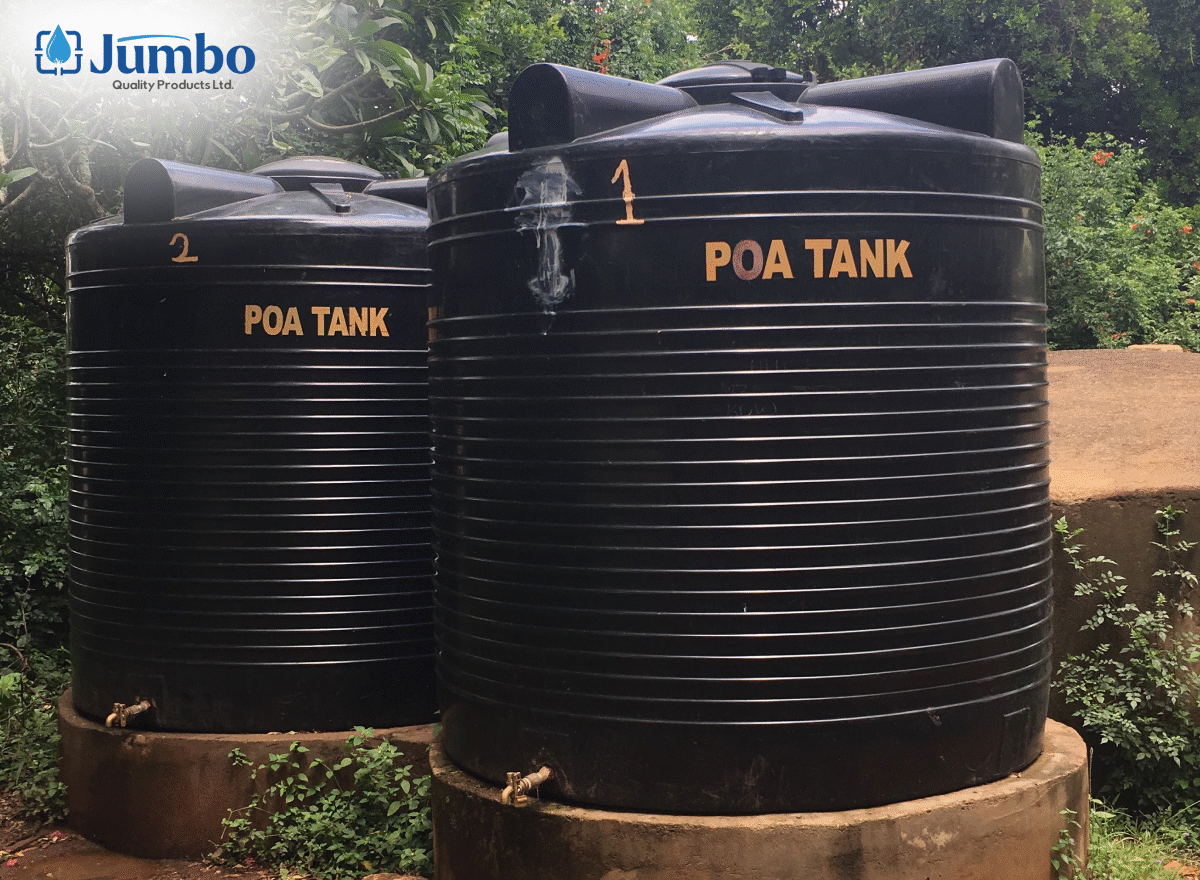
Polyethylene tanks are the most common choice on Kenyan farms. They’re UV-stabilised, food-grade safe, don’t corrode, and handle temperature swings reasonably well. Low-quality poly tanks crack within a season or two. Always check the wall thickness and ask whether the material is virgin or recycled polyethylene — the difference shows up quickly under the sun.
Tank Shape and Placement
Vertical cylindrical tanks take up the least ground space but require a sturdy raised platform for gravity-fed irrigation. Horizontal tanks are easier to transport to remote plots but hold less per footprint. For hillside farms, placement matters more than shape — a well-positioned 10,000-litre tank on a slope can irrigate by gravity alone, cutting pump costs entirely.
Fittings and Outlet Valves
A tank without proper inlet, outlet, and overflow fittings is a headache waiting to happen. When buying, confirm that fittings are included and compatible with standard Kenyan irrigation pipe sizes. Cheap fittings leak; leaks waste water you stored carefully.
For farms across Kenya, Jumbo Quality supplies large capacity water tanks built specifically for agricultural and commercial use — tanks sized and fitted for real working conditions, not just backyard storage.
Connecting Your Tank to an Irrigation System
A tank on its own is just storage. The real value comes when it’s connected to a proper drip or sprinkler irrigation system.
For most smallholder farms, a gravity-fed drip system connected to a raised tank is genuinely the most cost-effective setup available. No electricity, no pump maintenance, consistent water delivery directly to root zones. Water use drops significantly compared to flood irrigation — some farmers report cutting their water consumption by 40–60% after switching.
Larger operations typically pump from the tank to overhead sprinklers or row-drip lines. In that case, the tank acts as a buffer — it fills overnight from a borehole running at low capacity and empties slowly through the day as irrigation runs.
Maintenance That Actually Matters
Large capacity water tanks are low maintenance, not no maintenance.
Once a year, drain and inspect the interior for sediment build-up, especially if you’re filling from a river or dam. Check all fittings for slow drips. If you’re storing water for extended periods, a simple float valve to keep the tank topped up prevents stagnation better than any chemical treatment.
For farms in Kenya’s drier regions, a tank cover or lid is non-negotiable — open tanks lose significant volume to evaporation in hot months and become breeding grounds for mosquitoes.
The Practical Reality
Water storage doesn’t solve every farming challenge in Kenya. But it removes one of the most unpredictable ones.
A farmer in Meru who can irrigate through a six-week dry spell is in a completely different position to one who’s watching crops wilt and waiting for rain. The technology isn’t complex. The tanks are available. The question is whether you’ve sized your setup properly and connected it to a system that actually uses the water efficiently.
If you’re planning a new tank installation or replacing an ageing setup, Jumbo Quality has options worth looking at — from 5,000 to 100,000-litre capacity, with proper agricultural fittings included.