Water cuts do not send a polite warning. One morning, your taps are running fine; by midday, your production line has stopped, your staff cannot wash their hands, and you’re scrambling for alternatives that cost three times as much. If you run a business in Kenya, this is not a hypothetical. It is Tuesday.
That is exactly why so many businesses across the country are now investing in large-capacity water storage — and why the demand for the best water tanks in Kenya has surged across sectors from hospitality to manufacturing to agriculture.
Why Reliable Water Access Is a Business Problem, Not Just a Household One
Households can manage a supply disruption. They fetch water, they ration, they adapt. A business cannot do that at scale. A hotel in Nakuru cannot ask guests to skip showers. A food processing plant in Nairobi cannot pause hygiene protocols. A school in Eldoret cannot send 400 students home because the mains ran dry.
Water storage is, in practical terms, an insurance policy. And like any good insurance, you want it to be large enough actually to matter when you need it.
What’s Driving Demand for Large Water Tanks in Kenya?
Unpredictable Supply from Municipal Sources
Even where pipes exist, pressure drops and unannounced cuts are routine. Businesses that depend entirely on municipal supply are essentially operating on borrowed time.
Large water tanks in Kenya give businesses a buffer — days or even weeks of storage, depending on capacity — so operations can continue regardless of what happens upstream.
The Rising Cost of Water Bowsers
When the supply fails, and there is no storage, businesses call a water bowser. It works, but it is expensive. It is also unreliable during peak demand, which tends to coincide with exactly the moments when everyone else is also calling for one.
Businesses that have made the shift to large on-site storage report a significant drop in emergency water purchasing costs within the first year. The tank pays for itself faster than most people expect.
Agriculture and Irrigation Needs
Across the Rift Valley and central Kenya, farms are moving away from rain dependency and towards structured irrigation. That shift requires serious storage capacity. Small domestic tanks simply do not cut it. The farms that are scaling up — and managing consistent yields — are the ones investing in commercial-grade tanks in Kenya built for that volume.
Construction and Industrial Use
Active construction sites, quarries, and manufacturing facilities need large, consistent water reserves for dust suppression, concrete mixing, equipment cooling, and sanitation. These are not occasional needs. They are daily operational requirements that make large storage tanks non-negotiable on serious sites.
What to Look for in the Best Water Tanks in Kenya
Not all tanks are the same. A business making this investment should think carefully about a few things before committing:
- Material quality — UV-stabilised polyethene is the standard for outdoor tanks. It does not rust, does not leach chemicals, and holds up to Kenya’s climate across years of use. Thin-walled tanks crack. They are cheap for a reason.
- Capacity sizing — Buying a tank that barely covers two days of usage misses the point. Calculate your actual daily consumption, then aim for storage that covers at least five to seven days. For agricultural use, model it around your driest months, not average rainfall.
- Food-grade certification — If the water stored will be consumed or used in food production, the tank must be food-safe. This is not something to cut corners on.
- After-sales support — A tank is a long-term purchase. A supplier who disappears after the sale is a problem waiting to happen. Look for suppliers who stock fittings, offer maintenance support, and have a real track record.
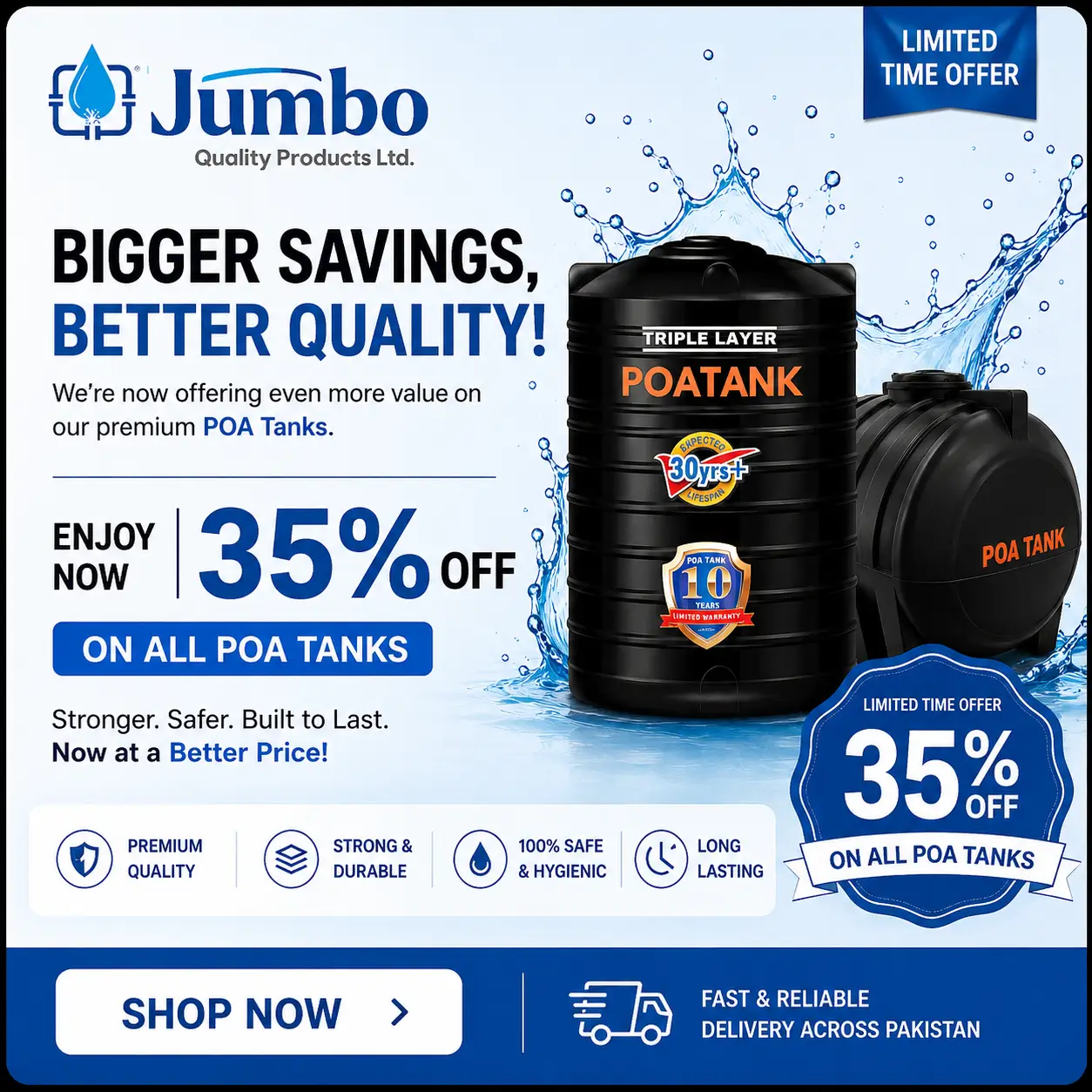
At Jumbo Quality, businesses across Kenya get access to tanks built for exactly these demands — designed for the country’s climate, sized for commercial and agricultural realities, and backed by proper support.
The Businesses Getting This Right
Across Kenya, the pattern is consistent. The businesses that invested in proper storage capacity two or three years ago are now the ones operating without interruption. They are not calling bowsers. They are not losing production days. They are not explaining to clients why something that should have been simple fell apart.
It is not a complicated calculation. Water is not going to become more reliable on its own. The infrastructure gap is real, and waiting for it to close is not a strategy.
Making the Right Choice for Your Business
If your business depends on water — and almost all of them do — the question is not whether to invest in storage. It is how much capacity you actually need, and who you buy from.
The best water tanks in Kenya are not necessarily the cheapest ones on the market. They are the ones that last, hold what they promise, and come from a supplier who knows what businesses actually need.
Talk to the team at Jumbo Quality to find the right tank for your operation — whether you need 2,000 litres or 50,000. Get the capacity right the first time, and it is one less thing you will ever have to worry about again.